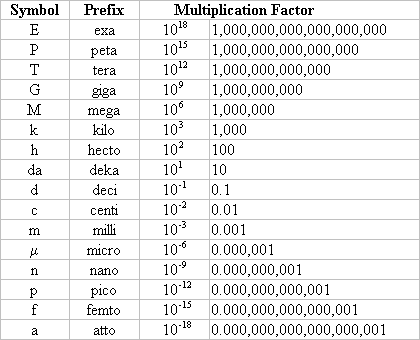
lab 19 due monday
labs 21 and 22 due thursday
Lab 21 Pyramid production data
Friday, April 12, 2013

Monday, April 8, 2013
April 8th upon completion of the essays
1. Doubling Time Lab (due at end of period)
2. Solar Absorption Lab (due wed.)
Mock Data to be used in Solar absorption lab
Friday, April 5, 2013
This weekend
1. Prepare for exam on chapters 12,13 and 8. (tuesday)
2. For a good review for chapter 12 and 13 watch the film Kilowatt Ours
(this will not be enough to prepare you but it does give a nice overview)
3. Possible essays (monday)
(remember that these are only 1 option the other essay(s) will come from anything we have covered this year)
4. Start reading chapter 6 and 7 (we will begin lecture on chapter 6 on Wed and chapter 7 on Thursday)
2. For a good review for chapter 12 and 13 watch the film Kilowatt Ours
(this will not be enough to prepare you but it does give a nice overview)
3. Possible essays (monday)
(remember that these are only 1 option the other essay(s) will come from anything we have covered this year)
4. Start reading chapter 6 and 7 (we will begin lecture on chapter 6 on Wed and chapter 7 on Thursday)
Thursday, April 4, 2013
Wednesday, April 3, 2013
Tuesday, April 2, 2013
Renewable resource essay
. Anaerobic methane digesters have been used for many years to reduce energy costs on farms throughout Europe
and on some large farms in the United States. The digesters operate by using anaerobic bacteria to break down
animal waste. During the process, which typically uses a tank heated to about 100°F (38ÁC) to speed the
reactions, raw manure is broken down and methane is produced. The methane can then be used to generate
electricity or produce heat.
For a certain dairy farm with 500 cows, the cost of installing a digester is approximately $400,000. Assume that
the farm uses 800,000 kilowatt-hours (kWh) of electricity each year at a cost of $0.10 per kWh. The waste from
a single cow can produce 3.0 kWh of electricity each day.
(a) Describe the steps by which methane produced in the digester can be used to generate electricity.
(b) Discuss TWO environmental benefits that may result from the installation of an anaerobic methane digester.
(c) Assuming that the cost of electricity remains constant and the farmer starts using the manure from the cows
in an anaerobic digester to produce electricity on the farm, calculate:
(i) The number of kWh of electricity that can be produced in one year
(ii) The amount of money the farmer can save in one year, NOT counting the installation cost of the
digester. (You may round your answer to the nearest $1,000.)
(iii) The amount of time, in years, that it will take to recover the cost of installing an anaerobic digester on
the farm. (You may round your answer to the nearest whole number of years.)
(d) Calculate the minimum number of cows the farm would need to produce 800,000 kWh of electricity
per year.
Subscribe to:
Comments (Atom)